KARPAK DEV
Apr 11, 2025
Value Growth Driver Model
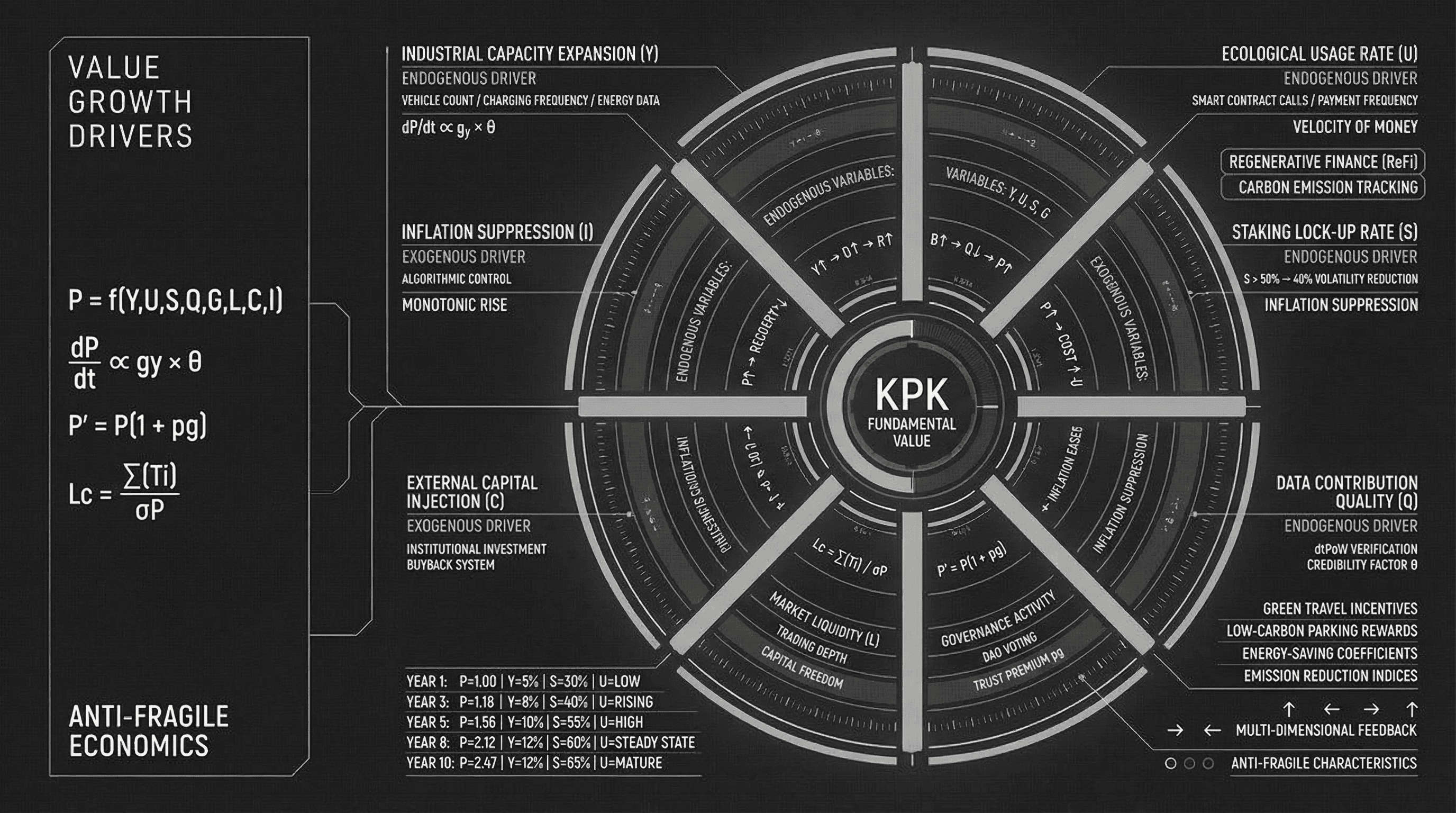
The value growth of the KPK token is not reliant on market speculation; rather, it is determined by a multi-dimensional feedback network of eight driving factors. This dynamic system ensures that the token's price scales sustainably alongside the expansion of the real-world mobility ecosystem.
The overall macroeconomic model is defined as:
Endogenous Drivers (Internal Ecosystem Factors)
These four internal variables directly reflect the network's productivity and community consensus:
Industrial Capacity Expansion
(Y): As the volume of verified real-world data (e.g., charging frequency, vehicle usage) increases, the token's fundamental valuation ascends. The theoretical price increment is expressed as:(Where
g_{y}is the annual growth rate of capacity and\thetaθis the data credibility factor).Ecological Usage Rate
(U): A higher frequency of smart contract calls and mobility service settlements enhances the token's cash flow attributes and intrinsic yield value.Staking Lock-up Rate
(S): High lock-up rates reduce market selling pressure and stabilize prices. Simulations show that when the lock-up ratio exceeds 50% of the total supply, price volatility decreases by approximately 40%.Governance Activity
(G): High DAO participation generates a trust premium (p_{g}), which acts as an additional price multiplier:
Exogenous Drivers (Financial and Institutional Variables)
These four external variables manage market liquidity and inflation:
Circulating Supply
(Q)& Market Liquidity(L): While increased supply can temporarily depress prices, it is necessary for long-term ecological vitality. The system algorithmically maintains liquidity at a critical value (L_{c}) to minimize price volatility (\sigma_{P}):External Capital Injection
(C)& Inflation Suppression(I): Institutional investments and industrial revenue buybacks are smoothed through smart contracts to prevent speculative bubbles. Concurrently, the algorithmic inflation model ensures that the efficiency of inflation suppression (I) rises monotonically over time.
Anti-Fragile Feedback Mechanism & ReFi Externalities
The interaction of these eight variables creates a two-way, self-stabilizing market.
Positive Feedback: Increased industrial capacity (
Y) drives higher demand (D), leading to more token recovery and burning (B), which reduces supply (Q) and increases price (P).Negative Feedback: If the price rises too quickly, transaction costs increase, temporarily cooling down the usage rate and easing inflation, preventing asset bubbles.
Finally, KARPAK embeds Regenerative Finance (ReFi) attributes into its valuation. Environmental and social externalities—such as carbon emission reductions and green travel metrics—are mapped into the data contribution weights. This ensures that KPK's value growth reflects both economic returns and quantifiable social benefits, adding a unique social capital premium to its market price.