KARPAK DEV
Apr 11, 2025
Allocation & Structural
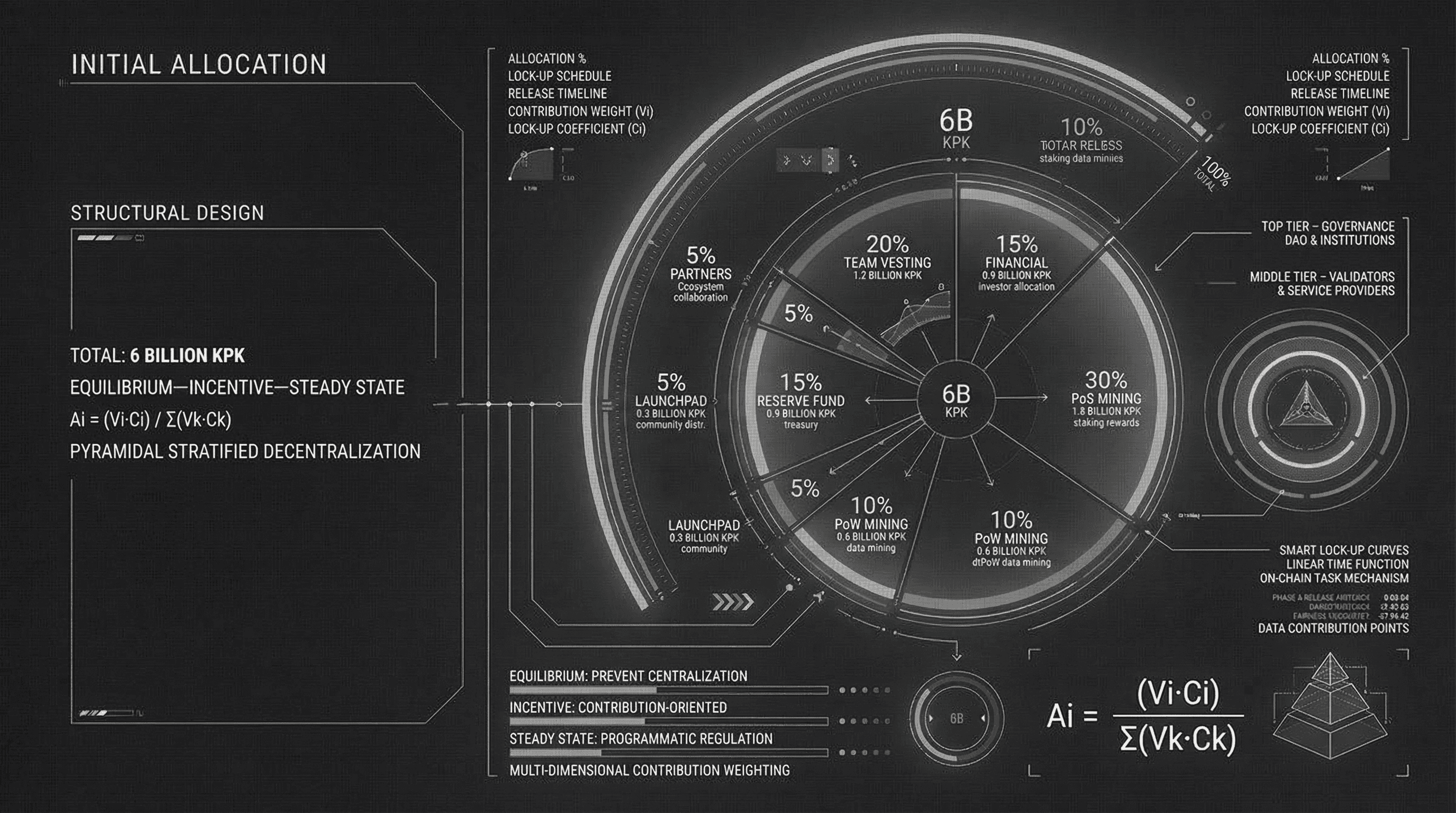
The initial allocation of the KPK token is engineered to balance early-stage ecosystem incentives with long-term macroeconomic stability, adhering to the tri-fold principle of "Equilibrium—Incentive—Steady State."
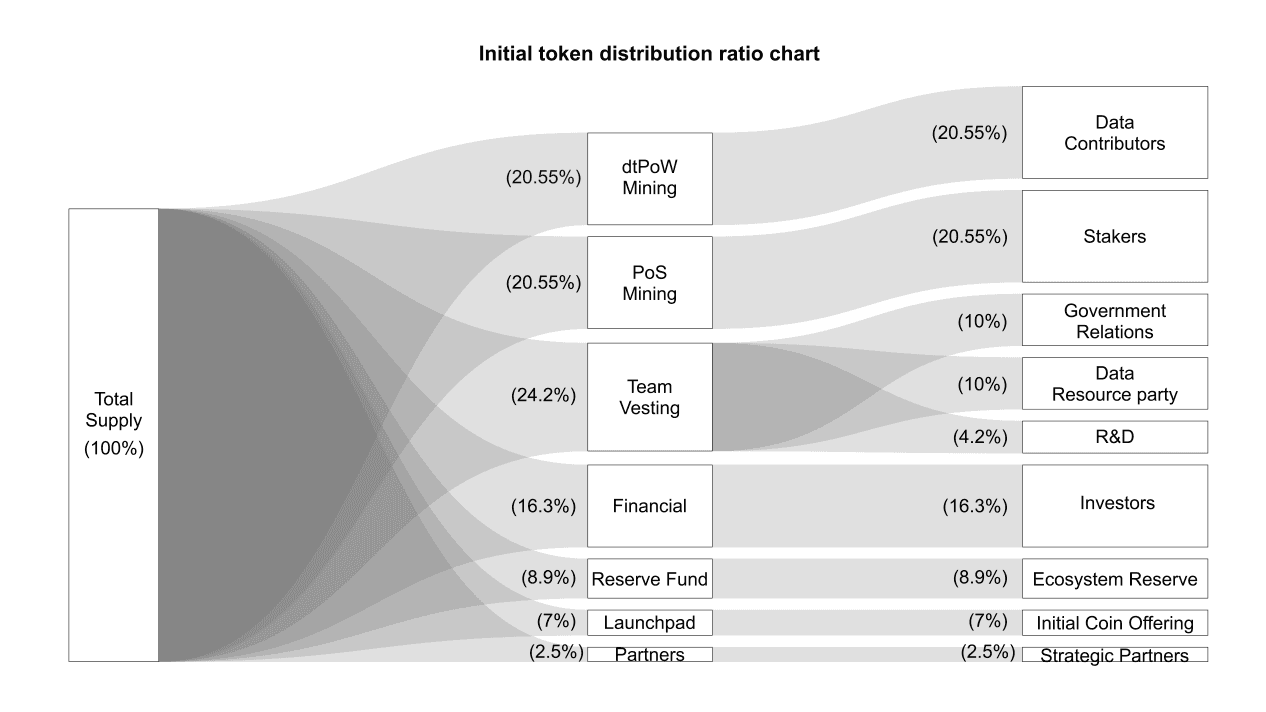
Initial Supply Structure and Fairness
The total supply of KPK is strictly capped at a constant baseline of 6 billion tokens. The distribution is strategically divided across key ecosystem pillars: Team Vesting, Financial reserves, PoS Mining, PoW Mining, Launchpad, Reserve Fund, and Partners.
To prevent early power centralization and mitigate price manipulation, KARPAK employs smart lock-up curves. Team and investor allocations are released in phases according to a predetermined linear time function. Conversely, the community allocation is strictly "contribution-oriented" rather than "capital-oriented," distributed dynamically through on-chain task completion and verified data contribution points.
Logical Foundation of the Allocation Model
The tokenomics framework introduces a "multi-dimensional contribution-weighted allocation" principle. This design allows capital investment, technical development, and data generation to be mutually balanced within the token economy. The programmatic logic for minting, issuance, and allocation is defined by the following equation:
(Where A_{i} represents the allocation ratio for group i, V_{i} is the expected contribution weight encompassing technical, ecological, and capital inputs, and C_{i} is the lock-up adjustment coefficient).
Impact on Ecological Evolution
A rational initial distribution structure is critical for establishing early market trust and ensuring the stability of later-stage decentralized autonomy. KARPAK’s programmatic regulation avoids the dual pitfalls of excessive centralization (which hinders ecosystem growth) and excessive dilution (which weakens participant incentives).
Instead, the protocol maintains a robust "pyramidal stratified decentralization":
Base Layer: A massive foundation of everyday data contributors forming the long-term participant group.
Middle Layer: Validator nodes and small-scale data service providers who secure and maintain the network.
Top Tier: The governance DAO and institutional investors who guide macro-strategy.
This distributed governance architecture provides a highly stable social and economic foundation for subsequent token circulation and gradual unlocking.