KARPAK DEV
Apr 11, 2025
KPK Token Lifecycle Model
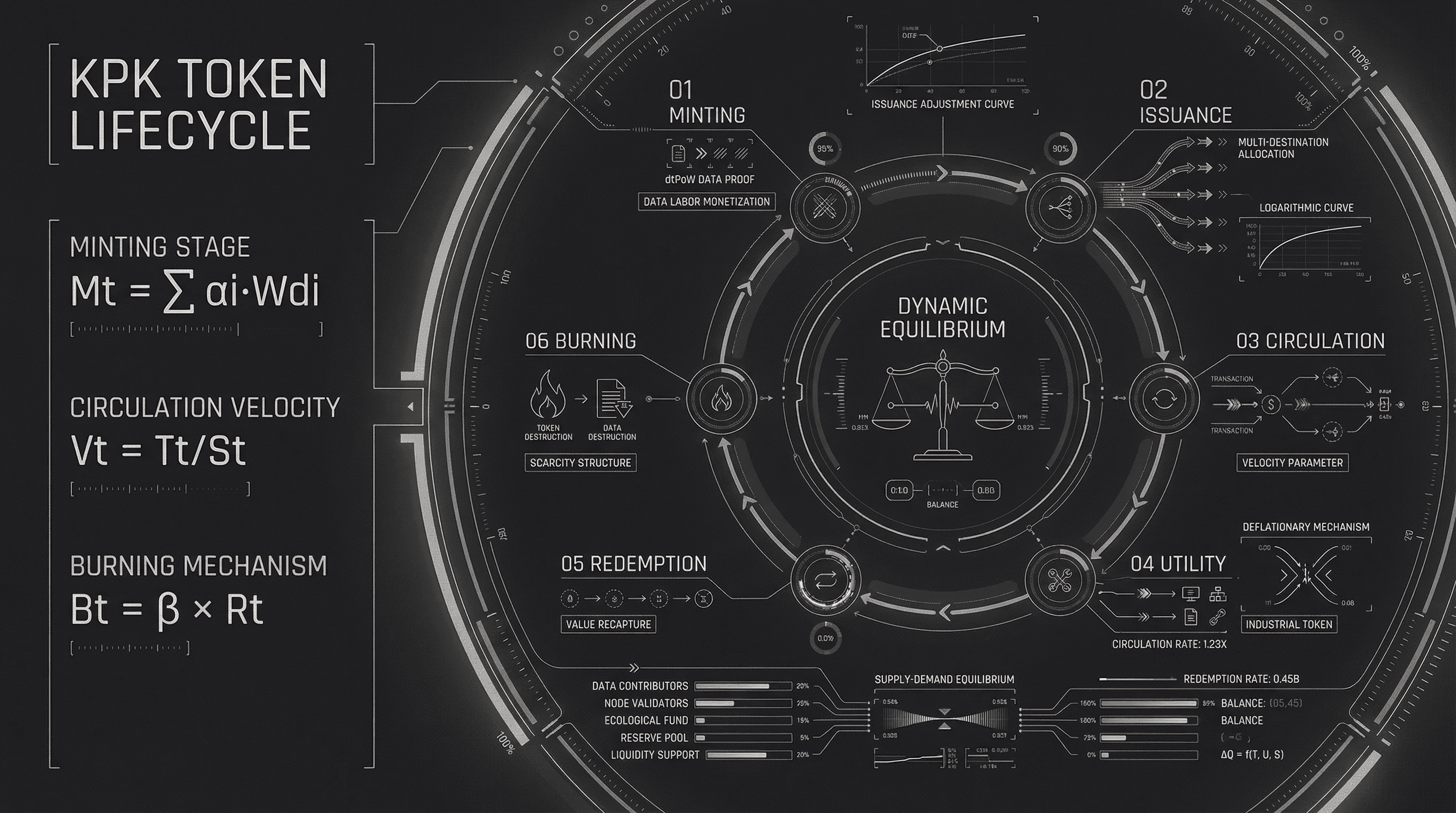
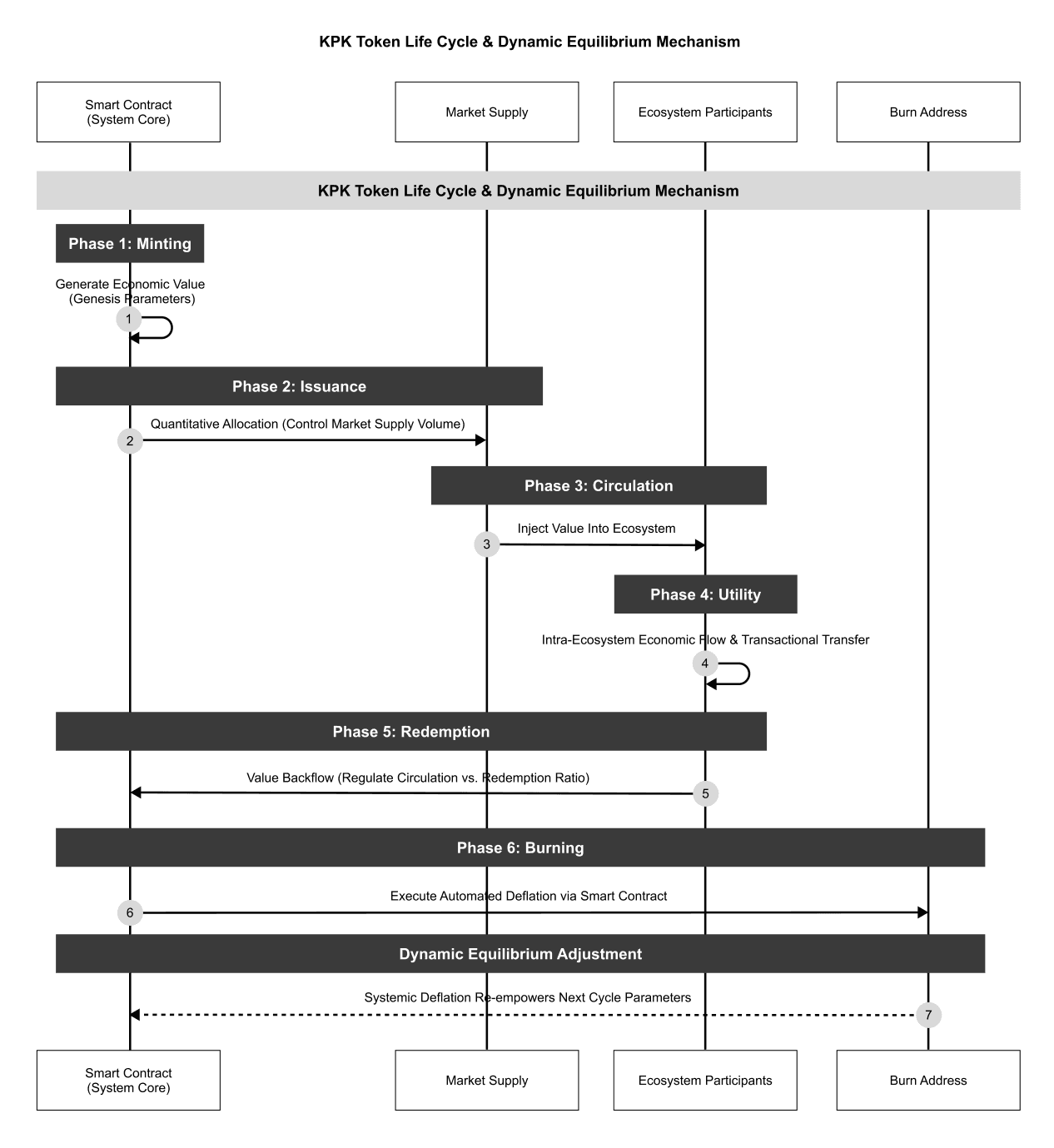
The KPK Token Lifecycle Model is designed as a continuous, dynamic closed-loop system. It ensures the sustainable flow of economic energy by transitioning the token through five distinct stages—from data-driven generation to automated deflation. This structure guarantees that the token's circulation and redemption rates remain perfectly balanced via smart contract regulation.
Minting Stage
The creation of KPK tokens relies entirely on the Data-based Proof of Work (dtPoW) mechanism. When verified real-world industry data (such as vehicle usage, charging records, and energy consumption) is submitted to the network, authoritative nodes calculate its economic weight. Upon approval, an equivalent amount of KPK is minted. This process fundamentally acts as the "monetization of data labor."
(Where \alpha_{i}αi represents the data contribution coefficient and W_{d_{i}} is the economic weight of the data).
Issuance Stage
Once minted, KPK is distributed across a multi-destination network, allocating funds to data contributors, validator incentive pools, ecological development funds, and liquidity reserves. The issuance rhythm is governed by a logarithmic decay curve. It releases tokens rapidly in the early phases to activate the ecosystem, and automatically converges in later stages to establish an endogenous deflationary mechanism.
Circulation Stage
Token circulation is propelled by two primary channels: users paying for on-chain services (e.g., parking and commuting contracts) and developers collecting transaction fees. The economic vitality of the ecosystem is measured by the velocity of KPK:
(Where T_{t} is the total transaction volume during the period, and S_{t} is the average token supply).
Utility Stage
In this phase, KPK transitions from a speculative "financial token" into a highly functional "industrial token." Its utility permeates the on-chain economy, serving as the primary medium for smart mobility contract invocations, infrastructure fee settlements, data authorization purchases, industrial carbon credit offsets, and decentralized governance participation.
Redemption & Burning Stage
To secure long-term supply and demand equilibrium, the protocol automatically executes token redemption based on real-time ecological parameters. A portion of the ecosystem's profits and transaction fees is recaptured and permanently removed from circulation through a burning contract:
(Where B_{t} is the amount burned, \betaβ is the burning ratio coefficient, and R_{t} is the total recaptured ecological revenue). This automated burning path ensures that KPK maintains a robust and predictable scarcity structure.