KARPAK DEV
Mar 28, 2025
Consensus Framework
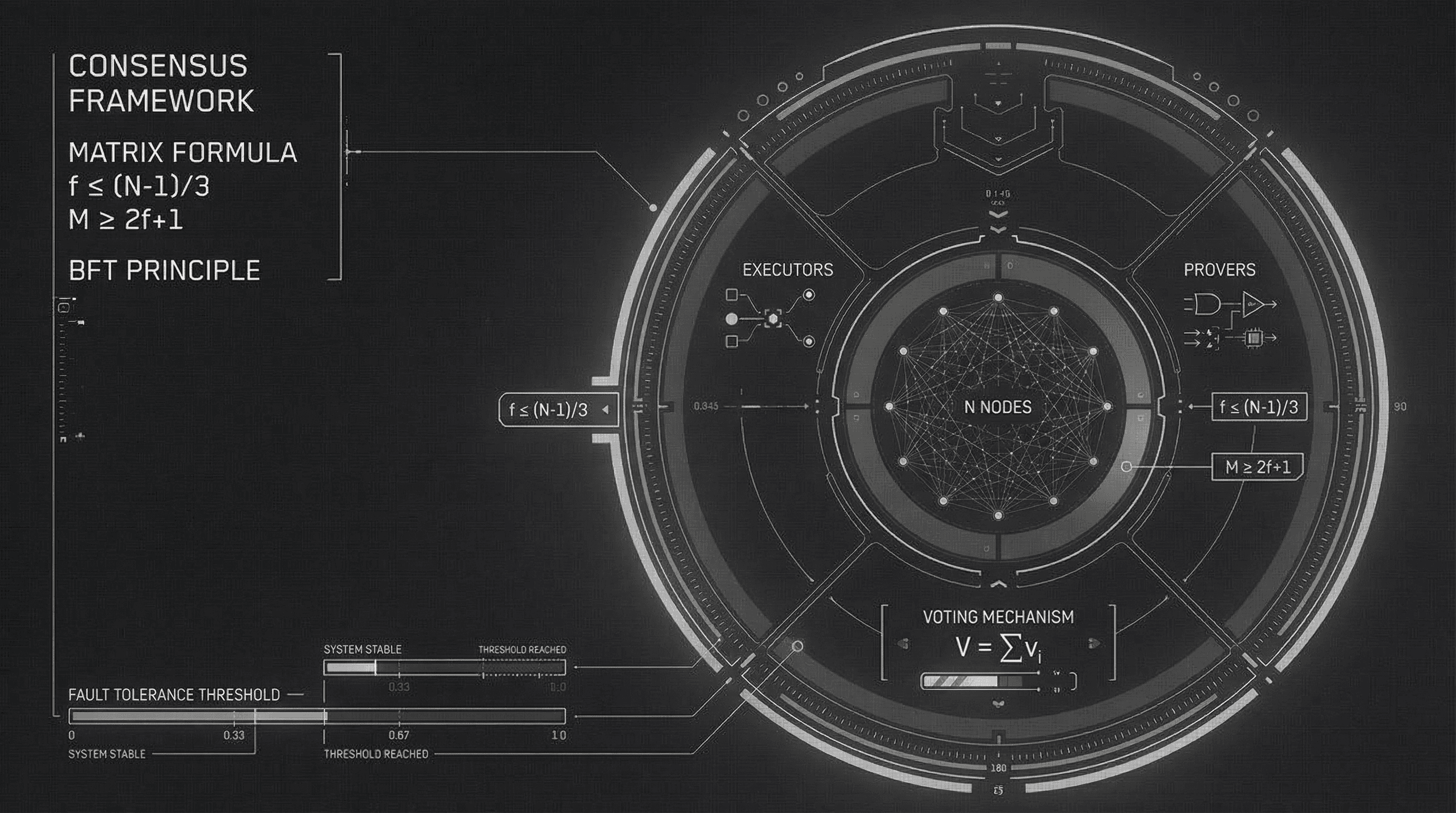
The consensus framework of the KARPAK chain is meticulously engineered to achieve deterministic agreement and secure system progression within a decentralized, trustless environment. By synergizing a proprietary Matrix Formula with the principles of Byzantine Fault Tolerance (BFT), the architecture establishes a unified mathematical guarantee that safeguards both the execution and governance layers against malicious attacks and node failures.
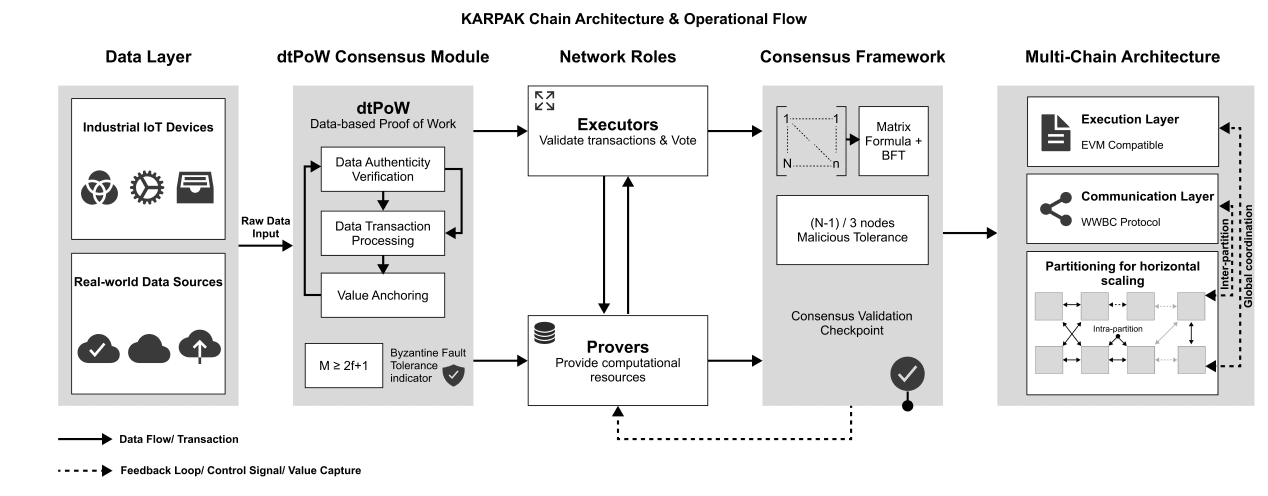
The Matrix Formula and Mathematical Foundations
At the core of KARPAK’s consensus is a quota-based mathematical mechanism that ensures data integrity and network consistency. Executors in the network are required to jointly validate transactions and computational outputs. The system mathematically defines its security thresholds as follows:
Let
Nrepresent the total number of executor nodes operating within the network.The system is designed to tolerate a maximum number of faulty or adversarial nodes, denoted as
f, which is strictly bounded by the inequality:
To achieve a valid consensus state, the network relies on a required quorum Matrix (
M), defined as:
This formulation mathematically guarantees that even if up to one-third of the network acts maliciously or goes offline, the remaining honest nodes will always constitute a strict majority, thereby preserving the robustness and correctness of the consensus.
Decentralized Voting and Majority Arbitration
To eliminate reliance on any centralized authority, KARPAK employs a highly redundant, majority-based voting mechanism.
Independent Execution: Multiple executors are assigned identical computational tasks. They independently process these tasks and cast a binary vote, where 1 represents approval and 0 represents rejection:
Result Aggregation: The final state is determined by aggregating all independent votes:
Quorum Satisfaction: A decision or transaction is only accepted as a valid consensus if the aggregated approvals meet or exceed the predefined quorum threshold:
Through this cross-validation process, erroneous or adversarial inputs are systematically identified and excluded from the chain.
Byzantine Fault Tolerance (BFT) Integration
In distributed networks, node crashes and coordinated adversarial attacks are inevitable. KARPAK integrates BFT principles directly into its Matrix Formula to ensure uninterrupted system progress.
By enforcing the condition M \geq 2f + 1, the network achieves Redundancy and Majority Arbitration. This means that the system does not merely trust a single computational output; instead, it relies on the redundant execution of tasks across multiple nodes. The BFT integration ensures that the protocol remains highly resilient and capable of reaching finality even under conditions of partial network failure.
Formalization of Network Roles
To optimize both computational efficiency and network security, the KARPAK consensus framework strictly bifurcates its participants into two distinct, interdependent roles:
Executors (The Arbiters): These nodes serve as the primary decision-makers of the consensus process. Their responsibilities include verifying transactions, executing smart contracts, and submitting votes. They enforce the Matrix Formula to maintain global state consistency and ensure that only valid data is recorded on-chain.
Provers (The Computational Engines): These nodes supply the heavy computational resources necessary to process complex tasks and large-scale industrial data. However, to maintain a trustless environment, the outputs generated by Provers are never accepted at face value. They must be independently validated by the Executors. This separation of powers introduces verifiable computation, adding a critical layer of redundancy and enhancing the overall security of the network.