KARPAK DEV
Apr 11, 2025
Release & Inflation Mechanisms
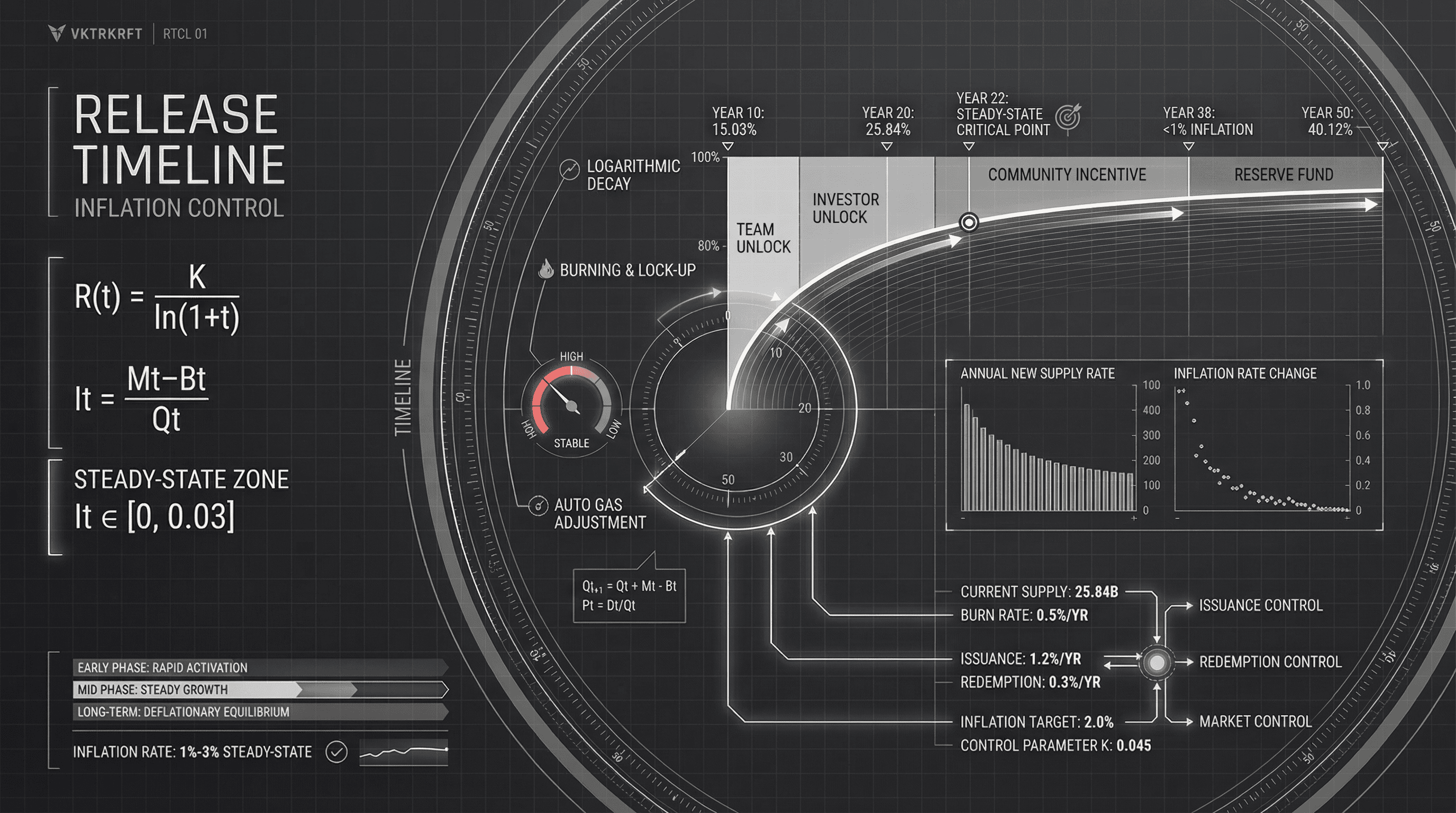
The KPK token release mechanism is engineered around the core principles of progressive release, market self-stabilization, and strict inflation control. Unlike traditional cryptocurrencies that suffer from speculative volatility and rigid supply shocks, KARPAK utilizes built-in smart contracts to dynamically adjust token supply based on time functions and ecological development, ensuring a predictable transition into a long-term deflationary steady state.
Logarithmic Incentive Release Model
KARPAK abandons the abrupt "halving" mechanism typical of traditional Proof of Work (PoW) systems. Instead, the token output for both dtPoW and PoS mining follows a smooth, decaying logarithmic function. This ensures rapid early-stage distribution to bootstrap the network, followed by a natural marginal decay that shields the market from severe supply fluctuations.
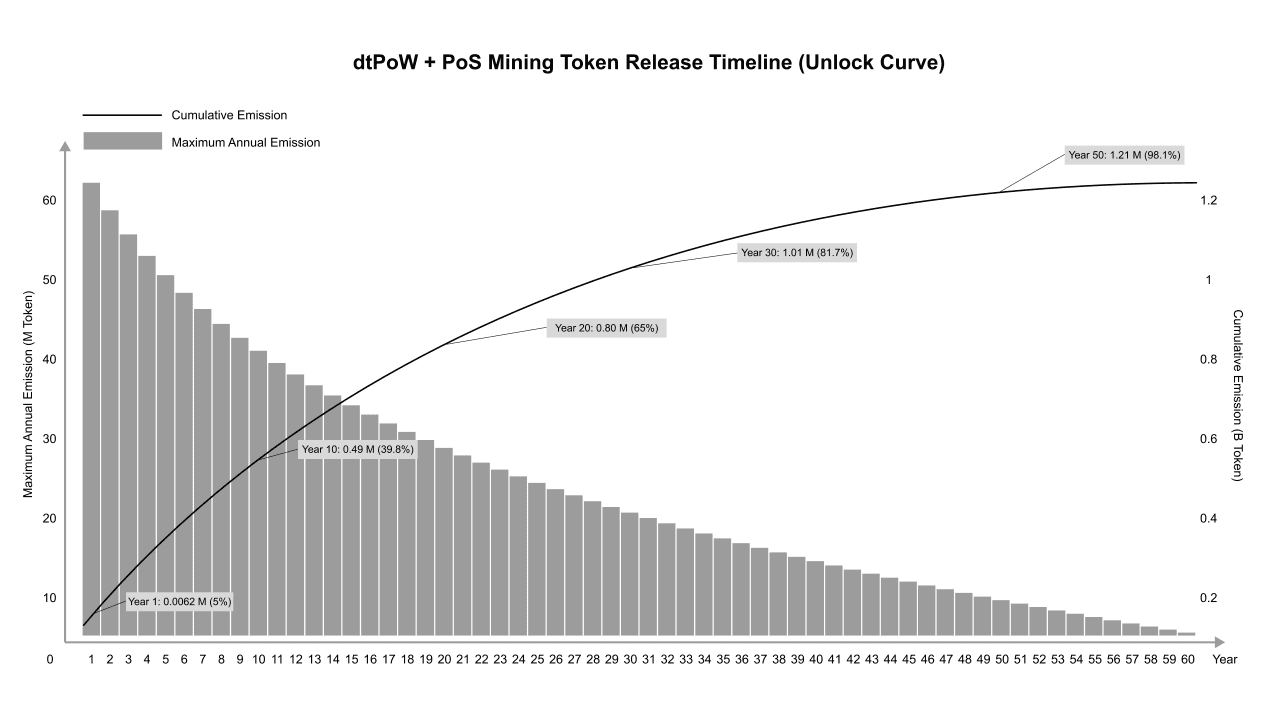
The marginal reward rate at time period t is defined as:
(Where K is the initial constant setting coefficient).
The cumulative release function over time is calculated as:
Triple Inflation Regulation Mechanism
To systematically suppress inflation and maintain the purchasing power of KPK, the protocol enforces a three-tiered control mechanism:
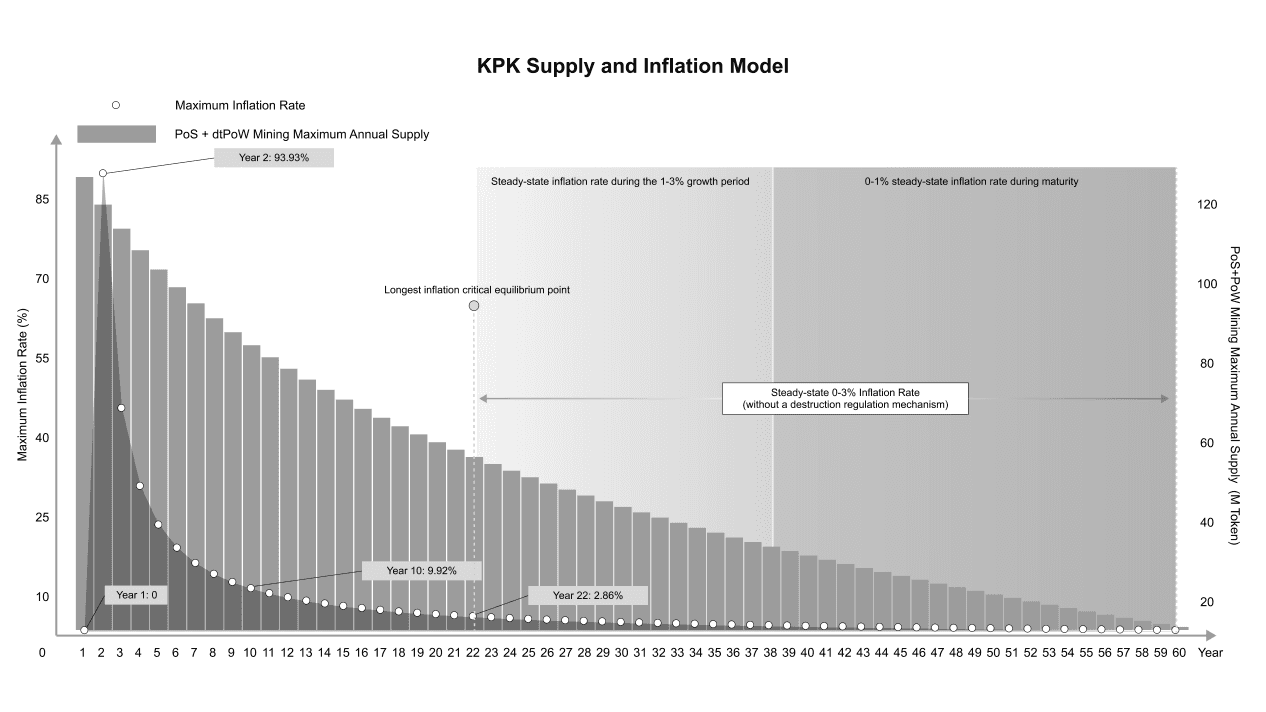
Issuance-Side Control: The logarithmic decay pattern naturally restricts the average marginal growth rate to less than 3%, providing mathematical self-constraint without requiring external governance.
Redemption-Side Control: The system periodically burns a portion of tokens derived from ecological profits, transaction fees, and governance consumption. Concurrently, the staking mechanism temporarily freezes over 80% of the circulating supply, drastically reducing token velocity.
Market-Side Control: Smart contracts adaptively adjust transaction fees based on network activity. High transaction frequencies trigger higher minimum gas fees to cool down inflation, while low liquidity prompts fee reductions to stimulate market activity.
Steady-State Equilibrium and Value Evolution
The ultimate goal of the KPK tokenomics model is to reach a low-inflation "Steady Zone." The total circulating volume Q and the inflation rate I for a given period are defined by the following equilibrium equations:
(Where M_{t} is the newly minted amount and B_{t} is the burned amount).
The system targets a steady-state interval where the inflation rate I_{t} remains between 0 and 3%. As the ecosystem matures, token circulation decreases due to burning, while ecological demand D_{t} rises. The long-term equilibrium price P_{t} is represented as:
By continuously expanding industrial utility while algorithmically constraining supply, KPK transitions from a standard utility token into a robust, value-appreciating asset.