KARPAK DEV
Apr 11, 2025
Reward & Distribution
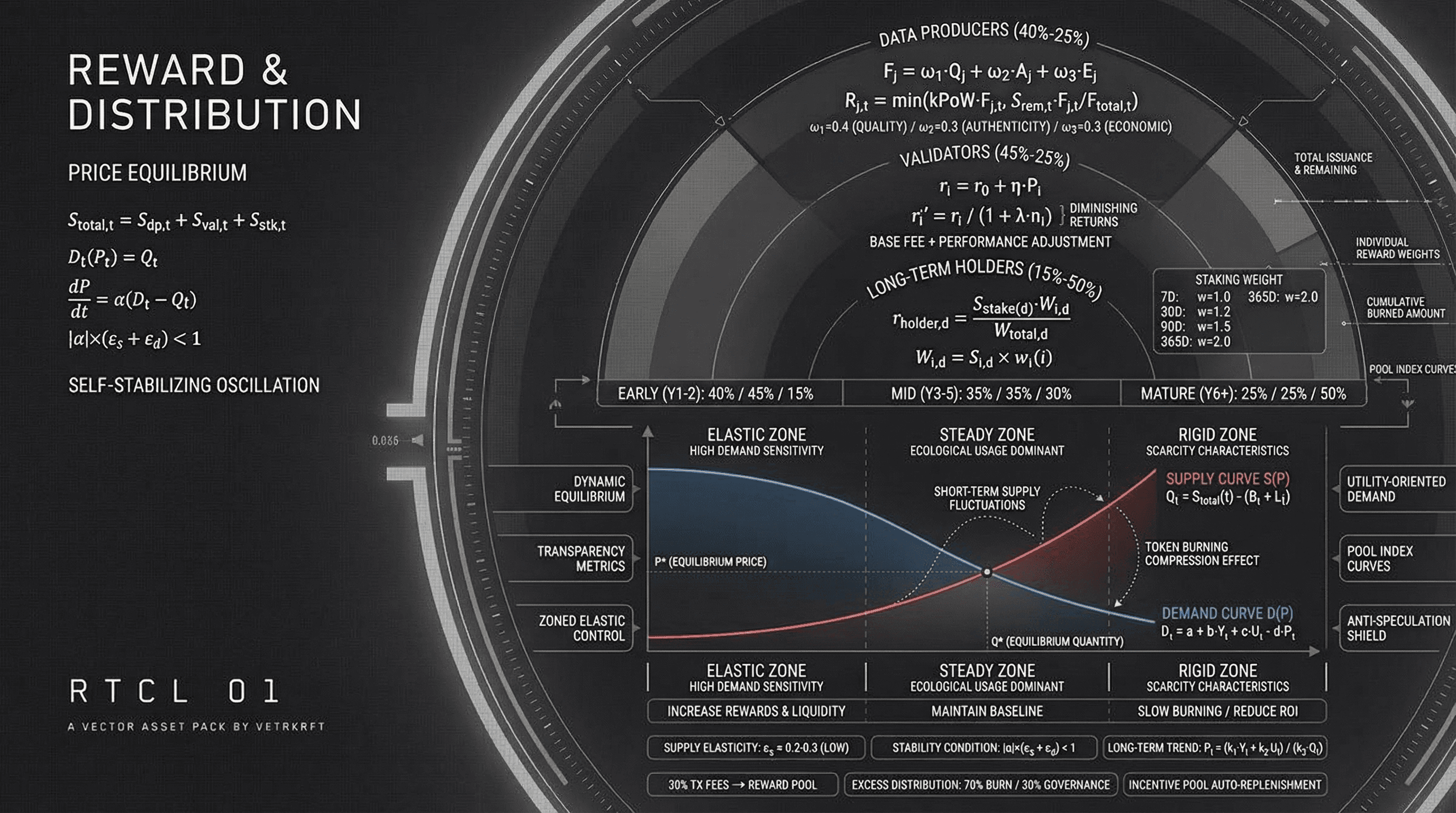
The KARPAK reward system is a dynamic, tiered incentive structure designed to compensate three key network participants: Data Producers, Validators, and Long-term Holders. The total reward pool is dynamically replenished by ecological revenues (such as transaction fees) rather than centralized scheduling.
The total reward source is defined as:
Data Contribution Rewards (Data Producers)
Rewards are distributed based on the quality, authenticity, and economic relevance of the submitted on-chain data. The system calculates a composite weight score for each data packet:
High-contribution data receives proportionally higher incentives, automatically preventing inflation caused by low-quality data spam.
Validator Rewards
Validators earn a base verification fee plus a performance adjustment factor based on the volume of successfully verified data. To prevent network centralization, a "diminishing marginal returns" formula is applied to large staked nodes:
Staking Rewards (Long-Term Participants)
Long-term holders stabilize the system by locking tokens. Yields are calculated based on a time-weighted metric, where longer lock-up periods exponentially increase the user's reward weight:
Dynamic Equilibrium & Evolution:
The incentive pool is continuously replenished by injecting 30% of daily transaction fees. If the pool exceeds a predefined limit, the excess is burned (70%) and sent to the governance fund (30%). Over time, the system transitions from early-stage data mining incentives to mature-stage staking and ecological commercial revenues.
Token Price Equilibrium and Market Dynamics Model
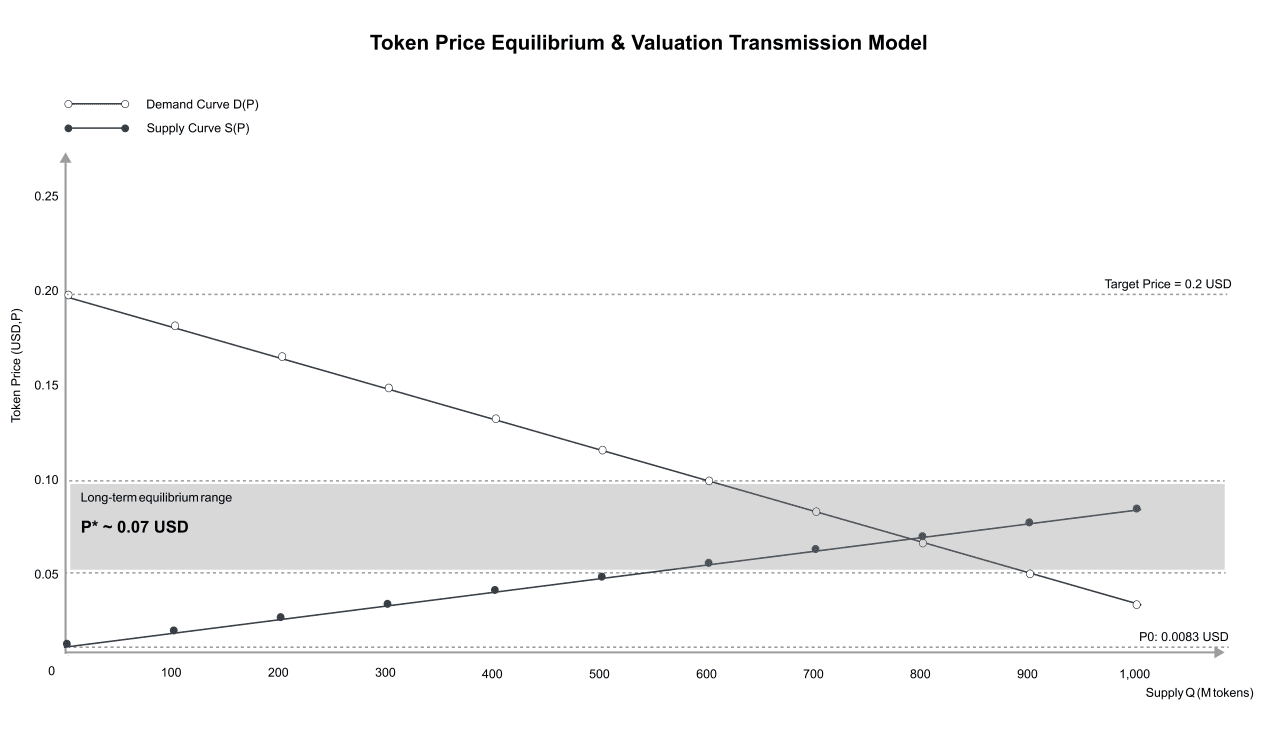
The KPK token price is not driven by market speculation but is anchored to real-world industrial output and ecological usage. The system's price equilibrium is determined by three mutually constraining variables: Token Supply, Ecological Usage Demand, and Expected Market Price.
Market Supply and Scarcity
The circulating supply is strictly constrained by automated burning and staking mechanisms.
Because of the fixed total supply and long-term lock-ups, the token exhibits extremely low supply elasticity. This restricted circulation enhances its store-of-value characteristics and provides strong resistance to inflation.
Utility-Oriented Demand
Demand for KPK originates internally from ecosystem utility (e.g., mobility services, smart contract calls) rather than external trading. The demand function is modeled as:
(Where Y represents industrial output and U represents ecological usage intensity). As long-term utility strengthens, the increments in industrial output and usage easily offset short-term price elasticity.
Short-Term Fluctuation & Long-Term Equilibrium
In the short term, price fluctuations are self-stabilized through automated inflation and burning feedback loops managed by the DAO's speed regulation function:
In the long term, the equilibrium price trend is a direct reflection of real industrial expansion:
As industrial output and usage frequency rise alongside ecosystem development—while supply remains constrained—KPK naturally exhibits a long-term upward value trajectory. The DAO regulates parameters across different market phases (Elastic, Steady, and Rigid zones) to shield the economy from asset bubbles.