KARPAK DEV
Mar 28, 2025
Network Architecture
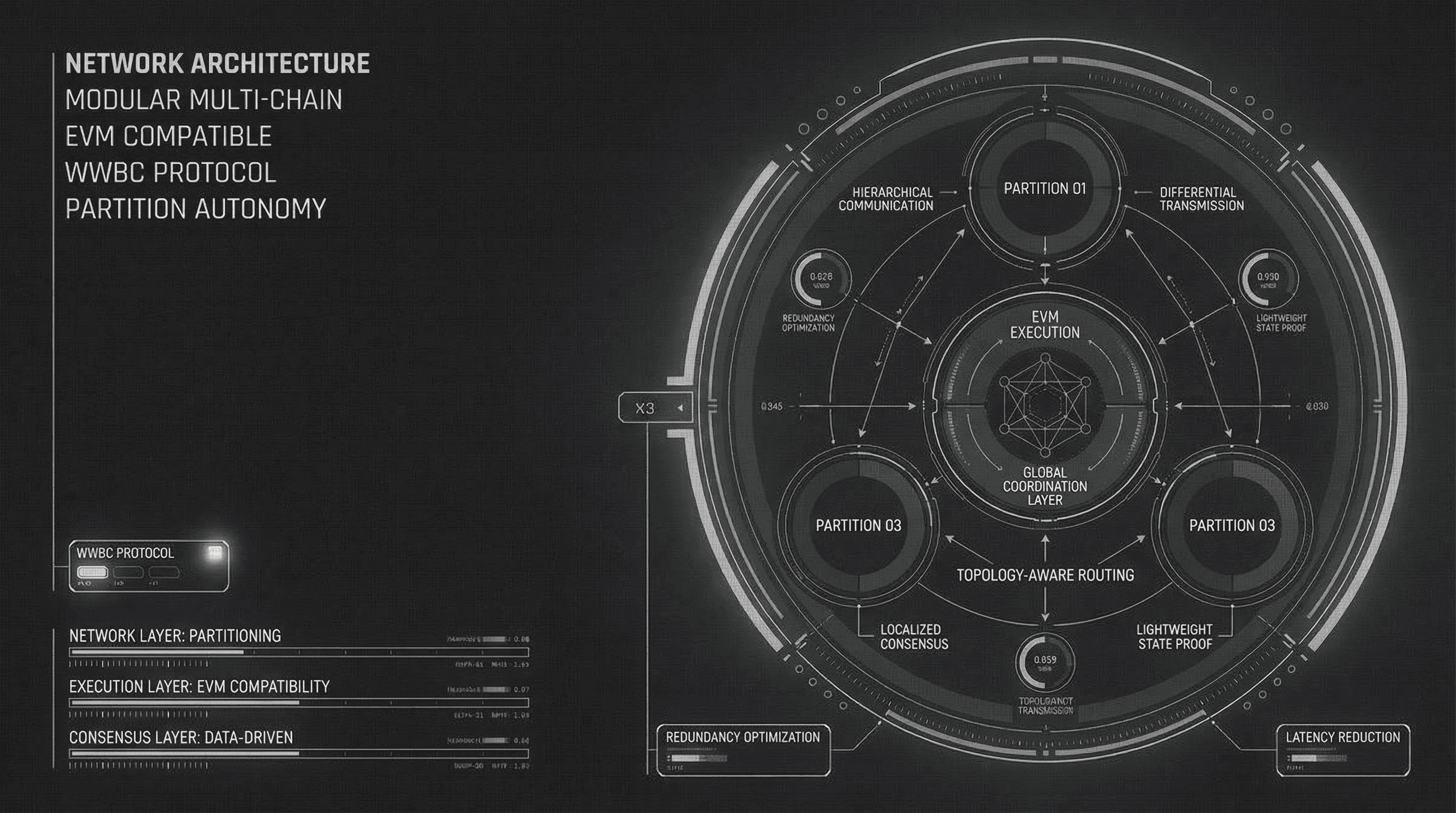
The underlying network architecture of KARPAK is engineered to support the massive data processing requirements of its dtPoW mechanism. By integrating a modular multi-chain topology with a fully EVM-compatible execution environment, the system achieves a critical balance between performance breakthroughs, horizontal scalability, and seamless developer integration.
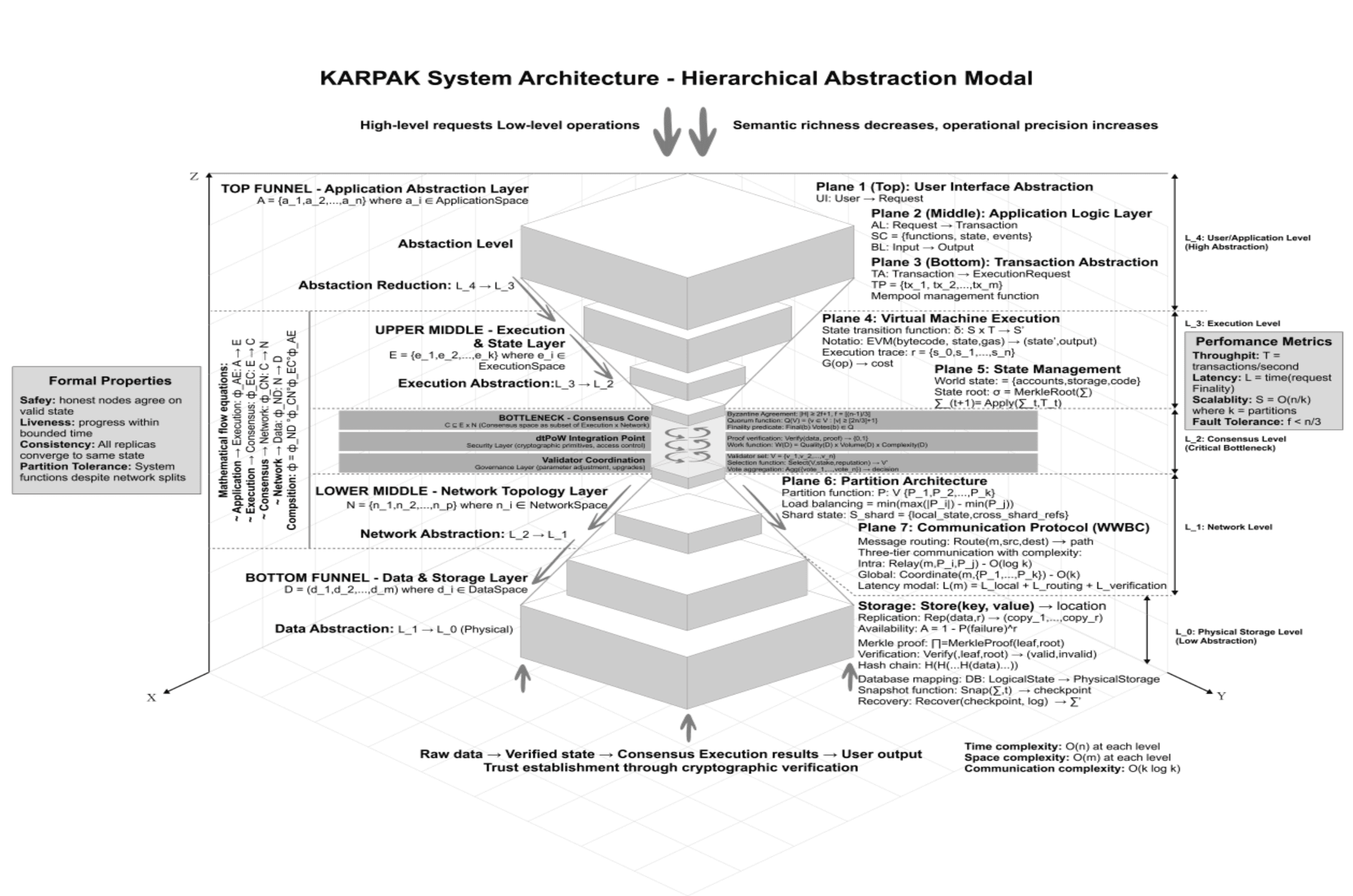
Rather than relying on the inefficient full-network broadcasting typical of monolithic chains, KARPAK operates on a highly specialized model of "localized partition autonomy combined with global coordination."
Network Layer: Partitioning and Interoperability
Traditional EVM blockchains suffer from low throughput and high latency because every transaction requires global consensus. KARPAK resolves this through a partitioned network mechanism:
Localized Autonomy: The network consists of multiple parallel-running blockchain partitions. Each partition chain independently executes data processing and consensus verification for specific industrial sectors.
Horizontal Scalability: By avoiding full-network broadcasts, the system can rapidly process large-scale industrial data locally. As the number of partition chains increases, the overall throughput of the KARPAK network grows sustainably.
Efficient Interoperability: Standardized cross-partition communication channels facilitate lightweight and secure state recognition and data transfers, ensuring global data circulation without creating network bottlenecks.
Execution Layer: EVM Compatibility
Despite its advanced partitioned network structure, KARPAK maintains strict EVM compatibility at the execution layer.
Ecosystem Continuity: Developers can continue utilizing existing languages (like Solidity), wallets, and frameworks. Existing DeFi and governance applications can be seamlessly migrated, effectively bypassing the "cold-start dilemma" faced by non-EVM chains.
Enhanced Performance: By embedding the EVM environment within a high-performance partitioned network, KARPAK allows smart contracts—crucial for dtPoW’s automated issuance and deflationary logic—to execute with significantly higher throughput and lower latency.
Consensus and Security Optimization
Traditional consensus models are ill-equipped to handle the high-frequency generation and validation of industrial data without complex Layer-2 workarounds. KARPAK’s architecture is natively optimized for data-driven adaptability:
Hybrid Verification: Partition chains first achieve localized data validation for rapid authenticity confirmation. Subsequently, the global coordination layer utilizes lightweight state proofs to establish cross-partition consistency, eliminating redundant global verifications.
Topology-Aware Communication: The network employs advanced routing mechanisms to reduce the propagation latency of verification messages, ensuring that security and efficiency are maintained simultaneously across large-scale, data-driven environments.