KARPAK DEV
Apr 11, 2025
Value Capture & Reflow Model
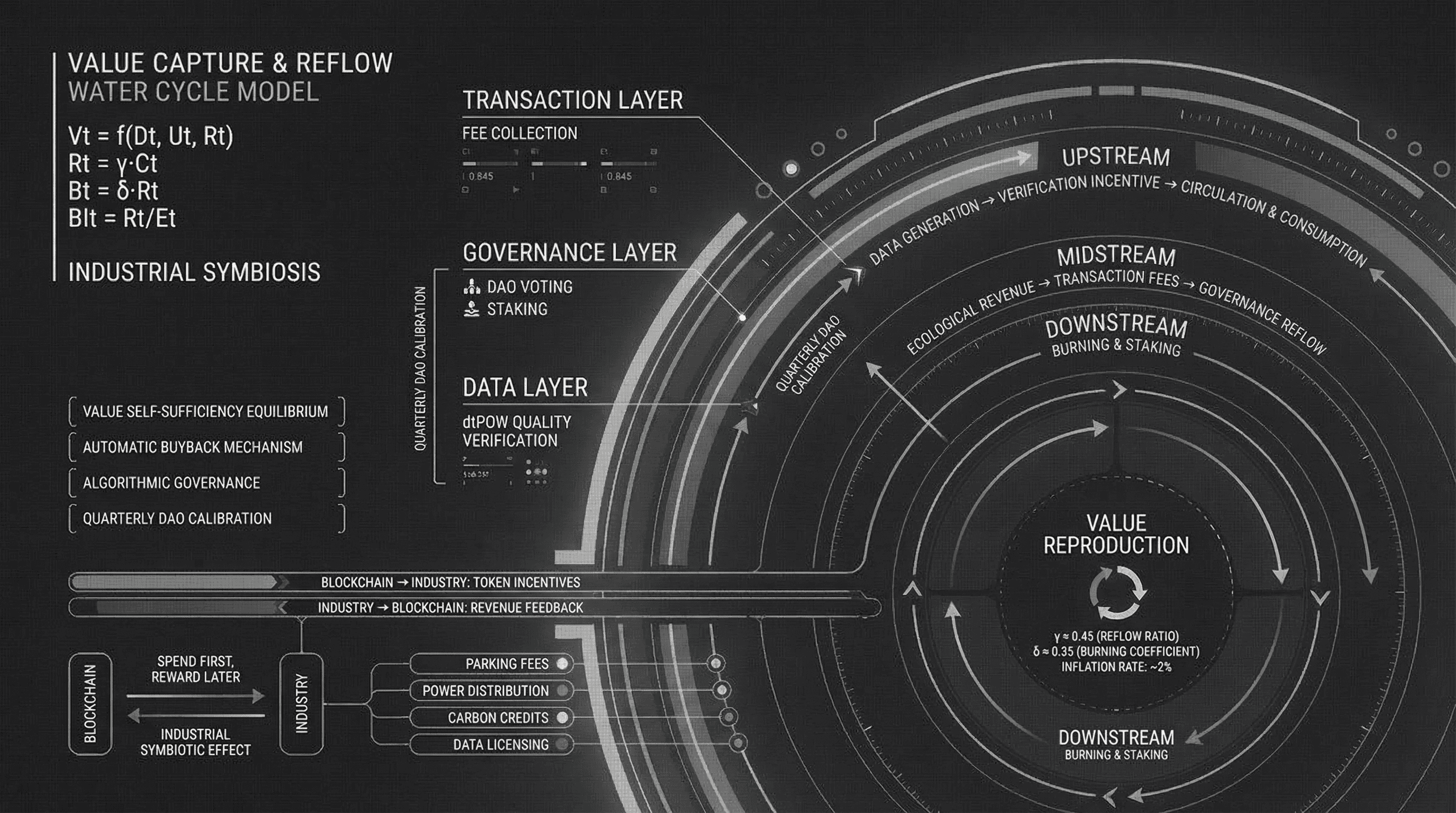
The KARPAK value capture model is designed as an "economic water cycle," ensuring that the KPK token derives its intrinsic value not from market speculation, but from a quantified, closed-loop system based on real-world industrial data. This mechanism operates on a continuous cycle: Data Activity → Incentive Issuance → Use Cases → Fee Reflow.
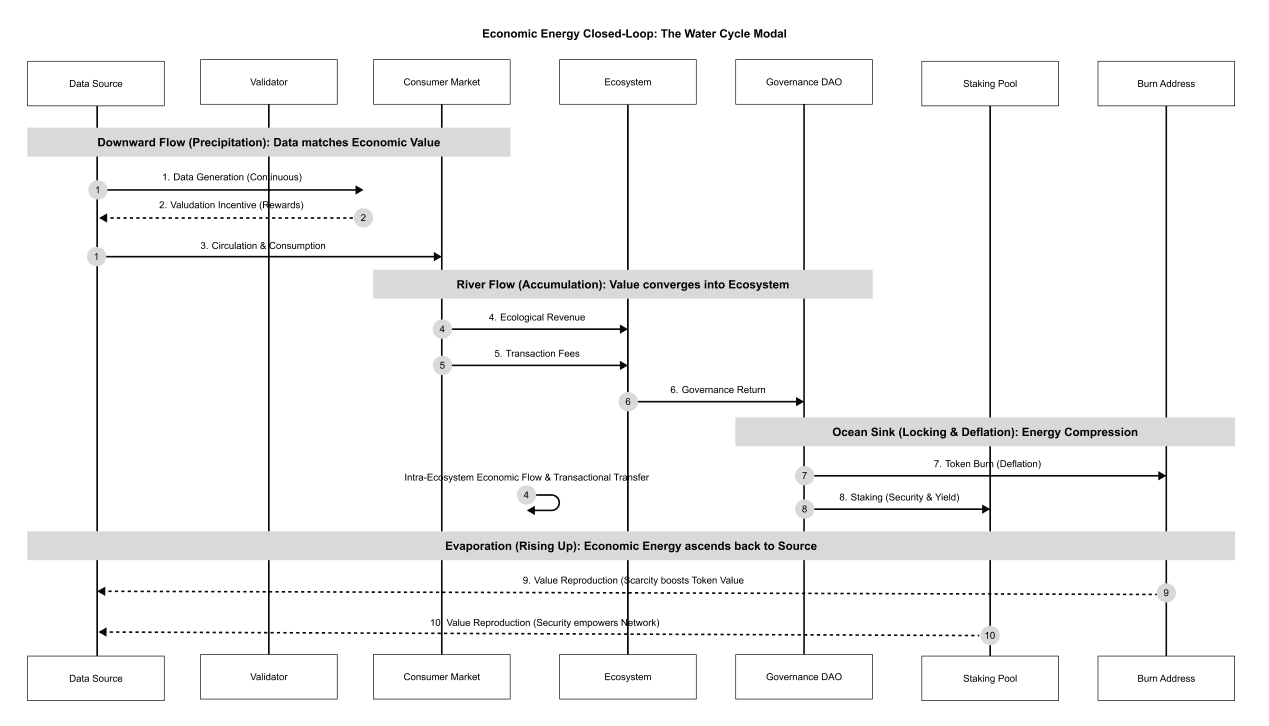
The Basic Logic of Value Capture
The overarching value of the KPK token is determined by the interplay of data output, ecosystem usage, and the rate at which value flows back into the system. The core logic is expressed as:
(Where V_{t} is the overall token value, D_{t} is the value of data output, U_{t} is the intensity of ecological usage, and R_{t} is the reflow rate). When R_{t} approaches 1, the system achieves a state of "value self-sufficiency equilibrium."
Multi-Layered Value Capture Dimensions
The ecosystem captures and recirculates value across three primary layers:
Transaction-Layer: All on-chain services (e.g., smart mobility, parking, data exchange) require transaction fees settled in KPK. These ecological profits are recovered and either redistributed or burned, turning transaction activity into a regenerative power source that compresses token supply.
Governance-Layer: Token holders who participate in DAO voting and staking earn yields. This acts as a redistribution mechanism, converting deflationary gains into governance dividends and routing value back to the network's core nodes.
Data-Layer: Under the dtPoW framework, validators must consume transaction fees and stake tokens to submit data. This "spend first, reward later" model forces participants to ensure high data quality, naturally filtering out noise and balancing the incentive pool over time.
Value Reflow Equation and Token Burning Path
To maintain a robust scarcity structure, the system mathematically dictates the volume of tokens recaptured and burned within each cycle:
(Where C_{t} is total ecological consumption, γ\gammaγ is the reflow ratio, R_{t} is the recovered amount, \deltaδ is the burning coefficient, and B_{t} is the final burned amount). By maintaining γ≈0.45 and δ≈0.35, the system sustains a low mid-term inflation rate (~2%) before gradually transitioning into a deflationary state as the ecosystem matures.
Yield Equilibrium and Algorithmic Governance
To prevent asymmetric incentives from creating a "value void," KARPAK utilizes a Balance Index (BI_{t}) to monitor systemic health:
(Where E_{t} represents the current incentive expenditure). If BI_{t} > 1, the system is in a high-reflow, deflationary state. If BI_{t} < 1, there is an inflationary risk due to insufficient reflow. The DAO automatically calculates this index quarterly, using it to algorithmically calibrate supply and demand dynamics.
Industrial Symbiotic Effect
Because KPK is deeply integrated with the real-world mobility industry, a portion of its value reflow is generated by external industrial cash flows (e.g., parking fees, carbon credit trading, and power distribution revenues). These external revenues trigger automated smart contract buybacks, locking or burning KPK. This creates a powerful two-way channel: token incentives drive industrial efficiency, while actual industrial revenue continuously feeds back into the blockchain to stabilize and support the token's price.