KARPAK DEV
Mar 28, 2025
Smart Contract Execution
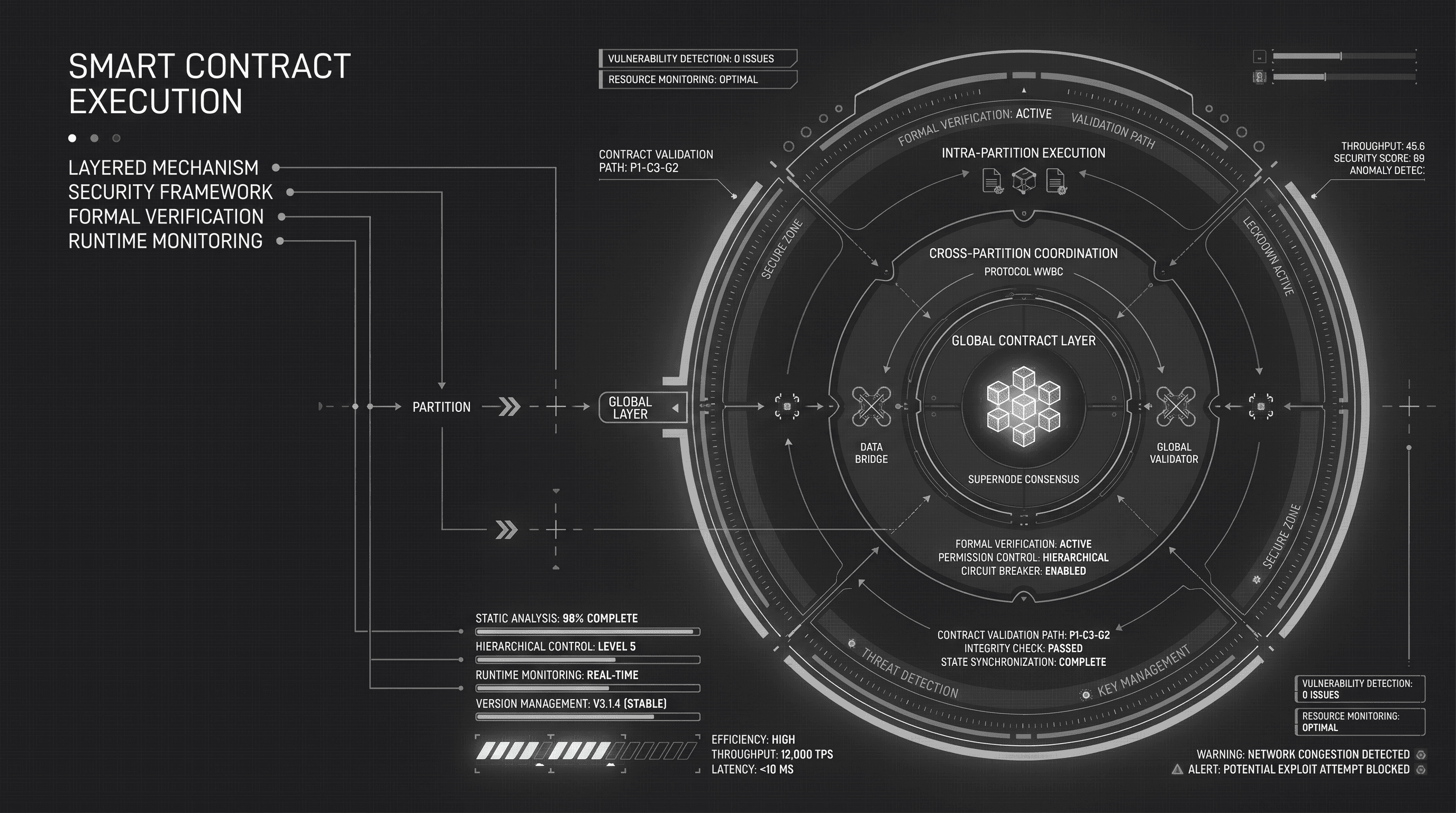
Traditional blockchain platforms face significant challenges in smart contract execution, including immutable security vulnerabilities, severe efficiency bottlenecks due to global computational redundancy, and uneven resource consumption. For a data-intensive system like KARPAK's dtPoW, these inefficiencies could lead to delayed data verification and systemic risks. To overcome these limitations, KARPAK implements a highly optimized, layered execution architecture paired with comprehensive security protocols.
Layered Contract Execution Mechanism
To achieve both local efficiency and global consistency, KARPAK abandons the "network-wide redundant execution" model in favor of a three-tiered architecture:
Intra-Partition Execution: Lightweight and high-frequency contract logic, such as industrial data format validation and basic measurement, is executed locally within individual partition chains. This prevents the global network from being bogged down by localized tasks.
Cross-Partition Coordination: For operations involving multiple partitions, KARPAK utilizes the WWBC protocol to transmit lightweight state proofs. Validation occurs either at the target partition or the global layer, ensuring secure and consistent interoperability without full-data replication.
Global Contract Layer: Mission-critical systemic logic—such as the dtPoW incentive distribution and final settlement—is deployed at the global coordination layer. These contracts are executed by supernodes and broadcast network-wide to guarantee absolute fairness and systemic consensus.
Security Measures and Trustworthiness
To safeguard the network against exploits and ensure the long-term sustainability of the dtPoW mechanism, KARPAK enforces a multi-layered security framework at the contract level:
Formal Verification & Static Analysis: Prior to deployment, critical smart contracts undergo rigorous automated vulnerability detection to eliminate common logic errors (e.g., reentrancy or overflow attacks).
Hierarchical Access Control: Contracts operate under differentiated permission frameworks. Only authorized nodes or specific partitions can invoke critical functions, drastically reducing the attack surface.
Runtime Monitoring & Circuit Breakers: The network continuously monitors resource consumption and execution behaviors in real time. If anomalous activities—such as malicious infinite loops or excessive resource drains—are detected, an automated circuit breaker is triggered to protect network performance.
Upgradeable Framework: Utilizing proxy contracts and versioning mechanisms, KARPAK allows essential contract logic to be securely updated over time. This mitigates the traditional risks associated with immutable code while maintaining strict backward compatibility.